I was standing in front of an operator, observing the process improvement we had implemented on a production module (a TV line). The project was for a large Japanese consumer electronics company based in Jakarta, Indonesia. While I watched the production process, the operator in front of me began to murmur in Bahasa Indonesia. Apparently, he was complaining about the new production line configuration we had implemented, and he wasn't the only one grumbling. To me, it was nothing; I shrugged and told myself, "Why should I be concerned?" We had achieved a 20% productivity improvement on that project and delivered the savings as promised. The CEO of the company was happy! But looking back, was there anything else we should have done to ease the workers' complaints while still keeping our promise to the CEO, or better yet, to go beyond the target productivity gains?
The management consultant in me focused too much on one persona at the time… and, no surprise, it was the CEO of the company. We designed the processes to achieve the cost savings and productivity targets. We used industrial engineering tools and techniques (including human factors engineering and ergonomics), statistical analysis and the Lean approach to reach our goals. In the process, we relied heavily on our engineering design and our project management and implementation skills, believing that everything would work out our way. We also piloted our solutions with little objection from the control group. We did everything by the book, didn't we? Fast forward several years: I encountered Design Thinking at Big Blue (IBM), where it was then a newcomer in the field of innovation and product and process design. I didn't pay much attention to it, as I was busy spreading the gospel of Six Sigma, Lean, automation and quality improvement in the company. During one of my down times (yes, I did have one!), I came across an article by Tim Brown on Design Thinking, and voilà! The answer to the million-dollar question, "What else should have been done?", was staring me in the face.
Design Thinking was originally developed as a product design and innovation process. It hinges on the principle that the design of products and processes should be customer- or user-centric, or, in Design Thinking terms, "persona"-based. The starting point of the Design Thinking process is the discovery phase, where deeper insights about the persona are unearthed. A variety of methods can be used to gain a deeper understanding of the persona you are designing a product or process for. The more popular and structured approach is Empathy Mapping, a collaborative tool used to organize and synthesize insights into the persona's pain points around the identified problem. Below is the structure of a typical Empathy Map:
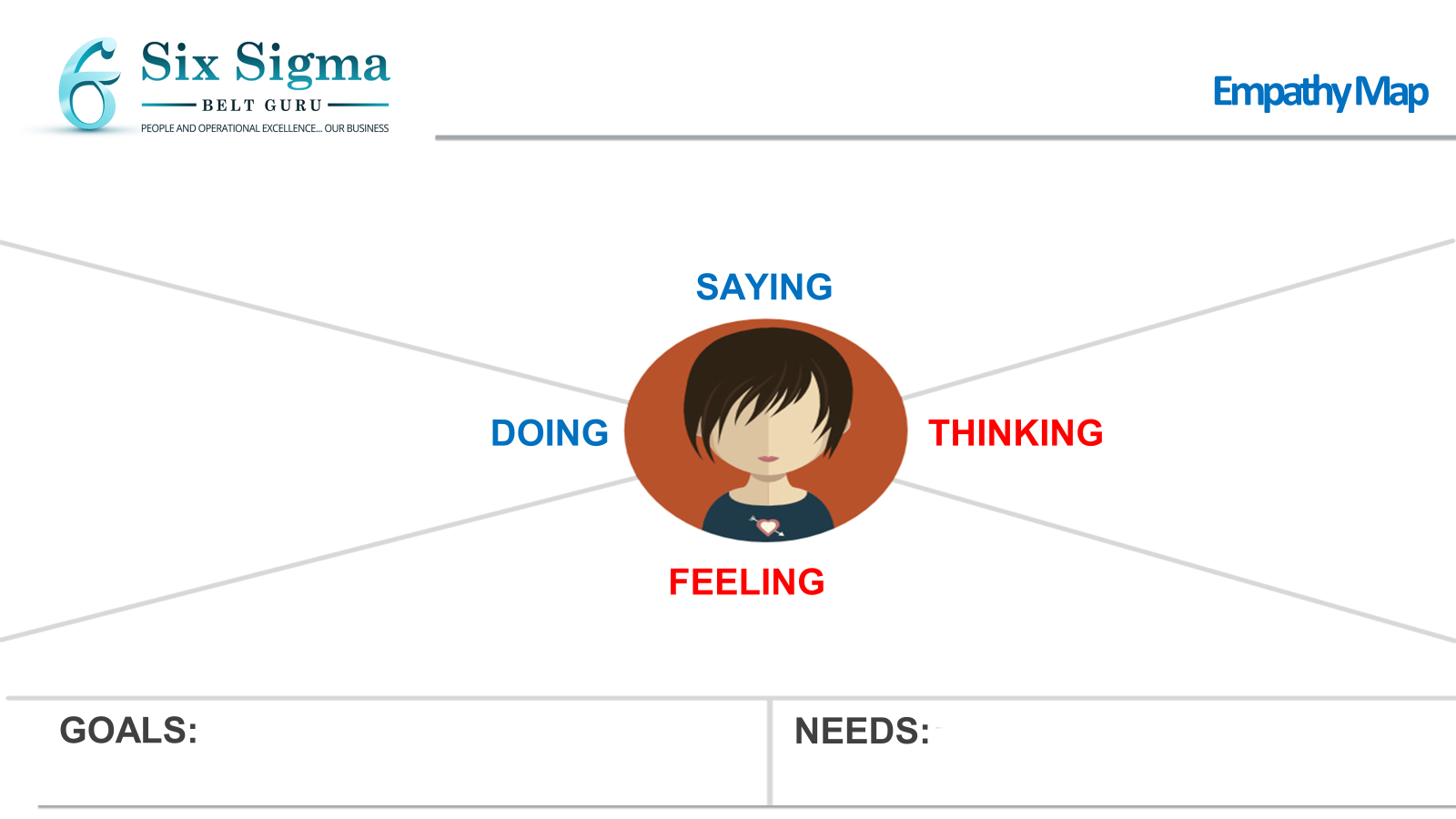
As with any collaboration tool, a team is convened to discuss and populate the chart with sticky notes (Post-it notes) that answer questions such as:
- What is the persona saying about their work or process?
- What do they think about the problem?
- How does this persona feel about their process?
- What steps does this persona take to handle the process problem?
The Empathy Mapping session surfaces key pain points that help in the later activities of the Design Thinking process, particularly the "Ideation" (idea generation) phase. To make the discovery phase more effective, the final Empathy Map should be validated by actually observing and interviewing the persona. Whenever possible, the team should conduct a DILO (Day in the Life Of…) of the persona to make the inputs in the Empathy Map concrete.
My earlier projects focused only on what we perceived as effective in achieving the business objectives. As in the consumer electronics project I managed, the solutions were all based on what we knew as engineers. We did use human factors engineering on that project, but it was based on prescriptive standards rather than on the operators' day-to-day circumstances. Worse, we didn't consider the operators an important persona when formulating our solutions. Perhaps by using the Empathy Mapping process and surfacing the pain points of that persona (the operators), we could have generated more ideas, combining improvements that required technical or technology changes with an acceptable working experience for the operators. This could have reduced the complaints from the line, since the manufacturing design would have had an element of user-centricity, and it could have yielded even better productivity and efficiency.
As change agents, we need to be creative and exhaust every possible avenue to drive process improvement. I have run and completed successful business process improvement projects, including the one in this article, but I can't claim that all of them were seamless and problem-free. My moment of serendipity with Design Thinking came too late for me to rectify decisions on previous projects; it was simply a matter of accepting that there is always a better way.