I have long been fascinated by how business process improvement and operational excellence methodologies have evolved over the years. In scholarly and academic circles, the discourse about this evolution is called "management fashion" or "management fad", and it traces back as early as the Industrial Revolution of the 19th century. These methodologies evolved with the changing industrial landscape and moved from the manufacturing sector to the services sector. Take Total Quality Management (TQM), which started as an approach to improving overall product quality by empowering the workforce and focusing intensely on customers' requirements. The early adopters of TQM were mainly from the manufacturing industry, but the approach itself is industry-agnostic, so its diffusion and institutionalization in the services sector was seamless. Moreover, TQM became the umbrella program for anything to do with continuous improvement. Approaches and programs of the '90s, such as Quality Circles, suggestion schemes and 5S, crossed paths with TQM and grew into staple organizational strategies for many industries in the Philippines.
It is in the nature of many management fashions that, at some point in their evolution, they come to be used together, not by design but because market needs make it necessary to integrate them. This brings me to the next potential crossroads of two potent approaches to continuous improvement and innovation: Lean Six Sigma and Design Thinking. I have worked in many industries and practiced continuous improvement long enough in my career to say that Lean Six Sigma is a fusion of elements of Total Quality Management, Statistical Quality Control, the Toyota Production System, Total Productive Maintenance and Industrial Engineering. These methodologies have one thing in common: finding ways to make products and services… faster, better and cheaper. Design Thinking, on the other hand, has a similar intent, but its process centres on empathizing deeply with the needs of the end user and developing solutions through prototyping. The Design Thinking literature describes it as a human-centred approach to innovation, one that does not focus on scientific methods or data analysis. The process is more concerned with the customer's experience once they use the solution that comes out of the Design Thinking exercise, and it iterates until the ideal solution is achieved.
So where will the crossroads be? These seem to be two totally different approaches to continuous improvement, problem solving and innovation. Lean Six Sigma is known for relying on empirical data, observable evidence and scientific methods, while the Design Thinking process revolves around empathy for the end user, ideation and prototyping. The answer lies in Dr. W. Edwards Deming's Plan-Do-Check-Act (PDCA) cycle! Both are grounded in Dr. Deming's popular PDCA cycle.
We know that the foundation of Lean Six Sigma's DMAIC methodology is the PDCA cycle. Now let's look closely at the five stages of the Design Thinking process:
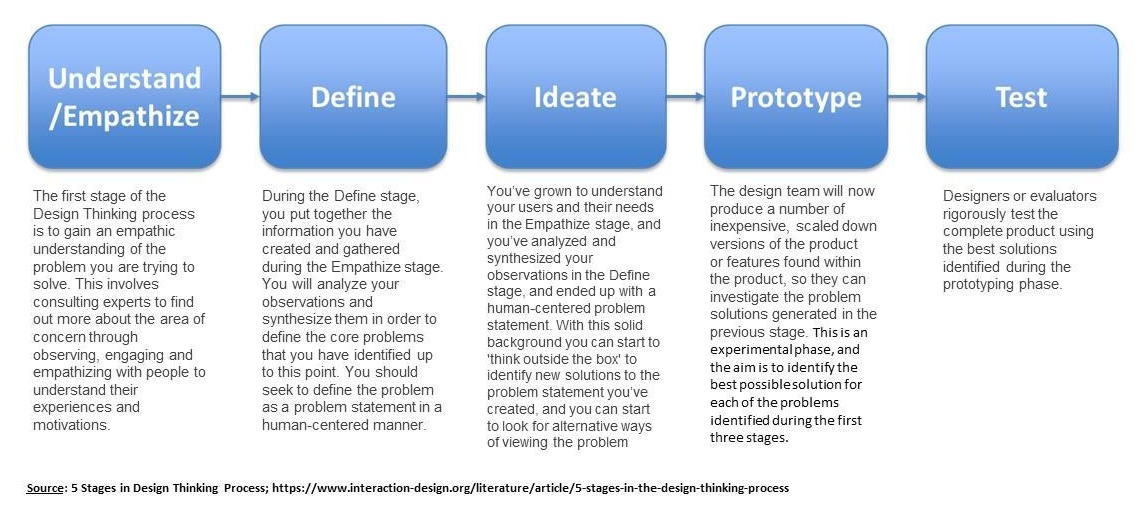
The framework on which Design Thinking operates has the same simple construct as the PDCA cycle and closely resembles the DMAIC methodology. Mapping the three models shows how they intersect:
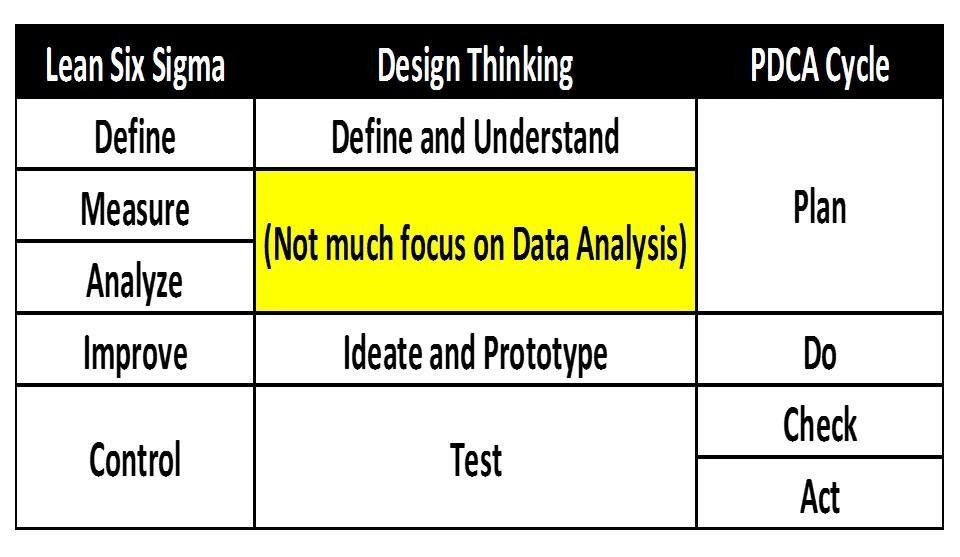
Since Design Thinking is a non-linear process, its elements can be integrated practically with the Lean Six Sigma methodology. In the mapping above, both Lean Six Sigma and Design Thinking have a laser-like focus on the Voice of the Customer (VOC). In Lean Six Sigma, we use techniques such as Kano Analysis or Quality Function Deployment to define our VOCs and CTQs (Critical to Quality requirements). Design Thinking, on the other hand, has a powerful technique for unearthing customers' or users' requirements called Empathy Mapping (I'll write more about this in my next article). Using these approaches in an organized way will make VOC determination more defined, even close to granular. Furthermore, in the Improve phase of a Lean Six Sigma project, the Belt would normally facilitate the generation of solutions, which are then prioritized, tested through experiments (if necessary) and pilots, and measured for effectiveness. These are the same processes as Design Thinking's Ideate, Prototype and Test. I believe it will be advantageous for a Lean Six Sigma project leader to leverage the tools and processes of Design Thinking's Ideate, Prototype and Test stages, especially when project solutions won't need deep mathematical modelling or an experimental design such as Response Surface Methodology.
The synergy of the two methodologies can be used in a variety of business situations, whether in product development and design or in business process improvement. As in any management fashion evolution, the integration of Lean Six Sigma and Design Thinking is inevitable; it's really a matter of when and how it will be diffused and adopted across industries. In my assessment, it's just around the corner…